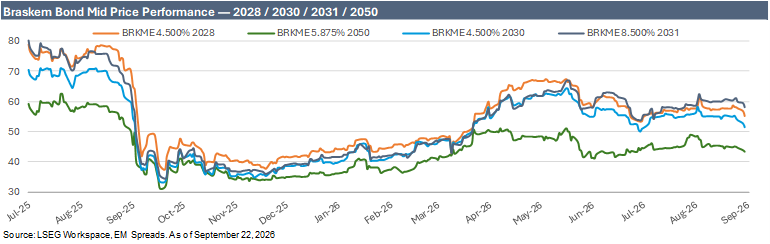
We move our recommendation on Braskem to Underweight from Neutral and shift our preferred expression across the senior unsecured curve to the BRKME 5.875% 2050s from the BRKME 8.500% 2031s. The downgrade is primarily a valuation call. Creditors are reportedly resisting Braskem’s latest proposal, talks have become more contentious again after the parties agreed to pursue the extrajudicial restructuring route, and recuperação judicial has returned more prominently to the discussions. At the same time, the reported terms give bondholders the first concrete indication of how Braskem may attempt to reduce debt rather than only extend maturities and capitalize interest. Yet the 2028-2041 senior curve is down only about 2.5 points on a face-weighted basis since our August 2Q26 report despite the more creditor-punitive restructuring framework, while the 2050s have fallen 5.6 points. The 2028s through 2041s currently trade between $51.4 and $58.2, with a face-weighted average of approximately $54.7, versus $43.3 for the 2050s. We rate the 2028s through 2041s Underweight and the 2050s Neutral. We prefer the 2050s because the lower dollar price provides more protection if restructuring treatment converges, while recognizing that the advantage can reverse if bond-specific coupons and maturities are preserved.
Braskem’s latest proposal reportedly asks creditors to provide approximately US$2.0bn of new money. About US$1.25bn would fund a repurchase of existing debt at up to 50% of face value, while US$750mn would fund working capital. The proposal at least addresses principal reduction, unlike Braskem’s original framework. The economics, however, still appear insufficient to create a durable balance-sheet solution if the new money is itself debt, reinforcing our view that Braskem ultimately requires both substantive creditor concessions and fresh shareholder capital. A group of bondholders is now reportedly asking Petrobras and IG4 to contribute approximately US$3.0bn of fresh equity, while multiple bondholders have indicated that they do not intend to provide additional funding themselves. We see the demand as further evidence that the current proposal remains far from consensual. It does not mean US$3.0bn of shareholder capital is likely to be provided.
The downgrade does not depend on the precise reported proposal terms. In August, the absence of a large collateralized layer ahead of the bonds was one of the main reasons we remained Neutral. That protection is now less secure. Negotiations contemplate creditor-funded new money, while proposals under consideration have included security interests over assets. Prices across most of the curve still provide limited recovery cushion, while the 2050s offer more price protection but remain exposed to the same unresolved restructuring risks.