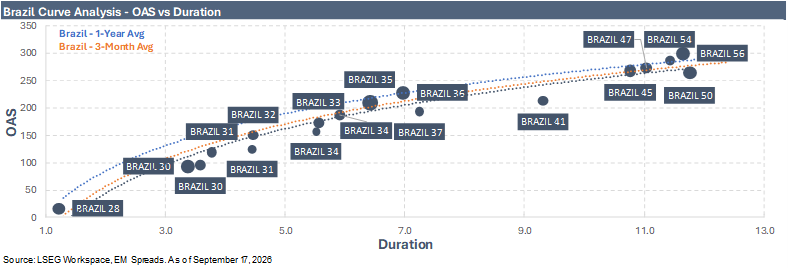
We move Brazil USD-denominated sovereign bonds to Underweight from Neutral. This is a valuation and event-timing call into the October 4 first round and the October 25 runoff, not a change in our credit assessment. Brazil’s external position is stronger than at our July initiation. Gross international reserves are near $370bn and projected to increase through 2028, FDI covers the current-account deficit and the sovereign funds predominantly in local currency. What has changed is the price, while the medium-term growth and rates mix has become less supportive of debt stabilization. Since initiation the 2029s have compressed 37 bps to 29 bps of OAS, the 2030s 32 bps to 94 bps, the 2031s 25 bps to 119 bps and the 2035s 17 bps to 209 bps. Over the same period, the LatAm Broad Bond Index USD compressed 8 bps to 231 bps. At current levels, Colombia trades wider than Brazil across most comparable points, while Mexico remains tighter. Every major point on the curve still trades within 8 to 19 bps of its one-year OAS minimum. The compression accelerated in September as several polls narrowed toward statistical ties and prediction markets moved toward the challenger. Over the same period our economic monitor’s 2027 growth forecast moved from 1.7% to 1.3% and its end-2027 Selic forecast from 10.6% to 12.3%, while the deficit, interest bill and debt projections remained unchanged.
We read that as the market pricing a change in fiscal regime that has not been delivered, by an administration that has not been elected, through a Congress that has not been seated. Prediction markets have moved further toward the challenger than the polling has. We treat that divergence as a positioning and event-risk signal, not as a forecast of the result. For the bonds, the relevant question is how much fiscal improvement current spreads already discount, not which candidate wins. Spreads at these levels provide some peer cushion but limited protection against adverse post-election fiscal outcomes. Two of the triggers we set at initiation have fired. We said we would reduce the belly preference if the 2035s and 2036s compressed without better fiscal evidence, and turn more defensive on fiscal slippage or a shift in the easing path. The belly compressed 8 to 17 bps without a corresponding improvement in the fiscal outlook. Fuel-relief measures carried a roughly R$40bn fiscal cost between March and September, and on September 17 the government announced a 15% increase in Bolsa Família benefits with an estimated additional cost of R$22bn in 2027. Investment and government consumption supported second-quarter growth while private consumption contracted, and the central bank is easing into 2027 inflation expectations that have moved higher. Gross debt still reaches 100% of GDP in 2027 on the general government definition in our economic monitor.
The Underweight is not a forecast of the election result. At current levels, valuation cushion is meaningful and the ordinary-case payoff is broadly balanced. Credible fiscal consolidation after the election could take the 2035s toward the Mexico 2034s at 176 bps, roughly 33 bps of compression and about 2.1 points on 6.4 years of duration. Fiscal slippage could instead retrace them toward the three-month average of 219 bps or the one-year average of 237 bps, a loss of roughly 0.6 to 1.8 points, with the one-year maximum at 278 bps implying about 4.4 points in the tail. The Underweight carries moderate conviction because the 2035s remain 21 bps inside our 230-bp Neutral re-entry area, sit only 18 bps above their one-year OAS minimum and 28 bps inside their one-year average, and the fiscal improvement required to sustain further country-risk compression has not been delivered. A constructive post-election fiscal signal could compress spreads quickly, but sustaining that move would require execution. Fiscal disappointment can reprice the curve before delivery becomes visible in the data.