We maintain our Opportunistic Overweight recommendation on CSN and shift our preferred bond to the CSN Resources 8.875% 2030s. We no longer recommend the CSN Resources 4.625% 2031s as our preferred expression, although we continue to view them as appropriate for accounts placing greater weight on downside protection than carry. We do not recommend the CSN Resources 5.875% 2032s or the residual CSN Inova 6.750% 2028s. The Opportunistic qualifier reflects CSN’s weak organic cash generation, tight parent-level liquidity and continued dependence on liability management and asset monetization, but we think current spreads overcompensate investors for the risk of principal impairment over our 9 to 12 month horizon.
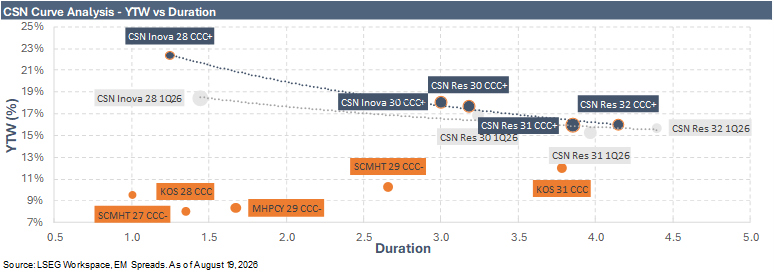
CSN’s USD senior unsecured curve carries a CCC+ composite rating, with Moody’s at Caa1, S&P at B and Fitch at CCC+. Against selected CCC-category comparables, the spread differential remains unusually wide. The CSN Resources 8.875% 2030s at 1,349 bps OAS trade roughly 570 to 940 bps wide of the selected Kosmos, MHP and Metinvest bonds shown in our curve analysis. The differential has widened through 2026 rather than representing a stable cohort premium. The selected Kosmos and Metinvest bonds are up approximately 27% to 62% YTD, while the CSN bonds are down approximately 7.5% to 14.9%, reinforcing that the spread gap is primarily issuer-specific rather than a generic lower-rated credit technical. Metinvest provides the clearest illustration. Despite direct exposure to the war in Ukraine, its 2027 and 2029 bonds trade roughly 720 to 780 bps inside the CSN Resources 2030s. We do not treat those spreads as fair-value targets, but the differential supports our view that CSN continues to price materially more credit stress than our base case assumes. The EM B index at 407 bps is more useful as a potential re-rating destination, leaving approximately 940 bps of spread between the CSN Resources 2030s and that benchmark.