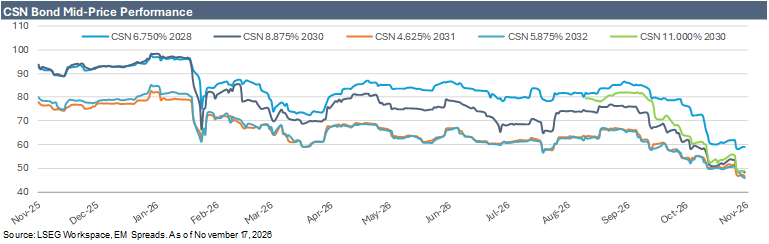
We lower our recommendation on CSN (Caa1/B-/CCC+) to Neutral from Opportunistic Overweight and retain the CSN Inova 11.000% 2030s as our preferred bond for investors holding exposure. This is a credit decision, and the bonds have not become expensive. The agreement to sell CSN Cimentos at R$12.7 billion in enterprise value delivered the catalyst on which our previous review relied. The 3Q26 results, however, exposed a weaker earnings and cash-generation base, and CSN Mineração’s reduced capacity to upstream cash meets one of the conditions we set for moving to Neutral. We also think the residual proceeds from the disposals may not be enough to stabilize parent-level liquidity without further refinancing and operating improvement. With the 2030–2032 bonds trading between $46.1 and $48.9, at yields to worst of 24.4–37.4%, we see value at current prices, but we have limited confidence in its timing and distribution, which will depend on the terms of the 2027 refinancing and on how CSN treats its discounted bonds once proceeds arrive. We would not sell at these levels, and we would use the Neutral stance to concentrate exposure in the Inova 2030s.
In our view, the change starts with cash generation. On our reading of the company’s free cash flow bridge, CSN consumed about R$1.0 billion on a consolidated basis in 3Q26 before working capital, after capex, interest, taxes, other financial results and jointly controlled EBITDA, and about R$1.5 billion including R$522 million of other items and capital contributions. Part of that sits at CSN Mineração, whose P15 spending rises to about R$2.7 billion in 2027 and whose cash is not automatically available to the parent. Working-capital releases, R$1.9 billion so far this year with a further R$900 million identified, have cushioned the outflow but cannot recur indefinitely. CSN has not disclosed how much of the US$1.2 billion secured bridge must be repaid from the cement proceeds. Assuming 80–100% is repaid, R$5.5–6.9 billion of the R$9 billion equity value would be absorbed at R$5.78 per US dollar, leaving an estimated R$2.1–3.5 billion before taxes, costs and closing adjustments. The SWT proceeds would initially be received by CSN Steel S.L., the Spanish selling subsidiary, and would need to be upstreamed to reach the parent. The parent’s funding gap was R$2.39 billion at September 30, or R$2.81 billion excluding the Usiminas shares, and R$4.71 billion of parent-company debt falls due in 2027. On our estimates, the cement sale alone would bring net leverage down to about 3.7x from 4.36x on LTM figures, before the effect of the weaker real on foreign-currency debt and before further cash consumption. The disposals buy time and reduce debt, but in our view they do not change the direction of the credit.