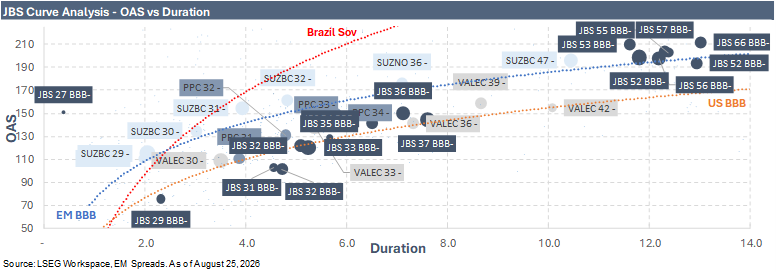
We move to Neutral on JBS (Baa3/BBB-/BBB-) from Overweight but retain a bond-level Overweight on the JBS 7.250% 2053 notes, making them our preferred expression over the 6.500% 2052s. We also shift our standard below-par alternative to the 6.375% 2066s, while retaining a separate deep-discount expression for price-focused mandates. This is a valuation decision before it is a credit decision. Our 1Q26 Overweight rested on a curve that paid investors across maturities for a leverage cycle we expected to prove temporary. Much of that compensation has now been collected where it was largest. The 2031 to 2034 bonds trade 12 to 19 bps inside their own 1-year averages, while the 2052-and-longer bonds remain within 8 bps of their respective 1-year averages.
Weaker credit metrics raise the bar for an issuer-level Overweight, but they are not the reason we step back. The sequential recovery in 2Q26 and the return to positive reported free cash flow reduce the concern created by the prior quarter. The leverage cycle has simply lasted longer than we assumed when we made the call. Company-defined net leverage of 3.10x now sits outside management’s 2.0x to 3.0x target, and our lease-inclusive measure of 3.45x sits further above it. We remain comfortable owning the credit because the liability structure gives JBS time. Average debt maturity is above 15 years, near-term maturities remain limited through 2030, and the liquidity buffer was strengthened again in August. JBS can carry an extended period of weak earnings without the balance sheet forcing a decision.