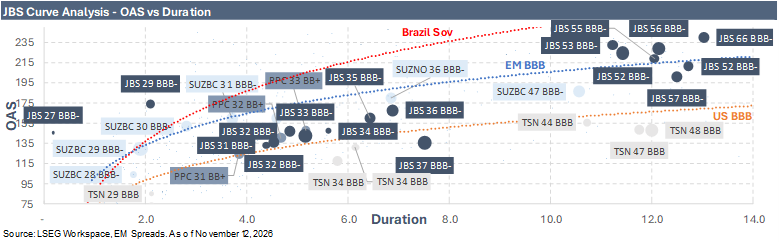
We maintain our Neutral recommendation on JBS (Baa3/BBB-/BBB-) and the bond-level calls from our 2Q26 report. The 7.250% 2053s remain our preferred long-dated expression with a bond-level Overweight, and the 5.500% 2036s remain our Overweight for US crossover investors. In the long end, the 6.375% 2066s remain our below-par alternative and the 4.375% 2052s our deep-discount expression. The rationale for Neutral has changed since our 2Q26 report. Then, the call was primarily valuation-driven, after the 2031 to 2034 bonds had re-rated to 104 to 132 bps OAS. Those bonds have since widened 16 to 32 bps to 133 to 148 bps and now sit 5 to 15 bps wide of their 1-year averages, while the long bonds other than the 2057s trade 7 to 15 bps wide of theirs. On valuation alone, we would be moving back toward Overweight. We maintain Neutral because the deterioration in 3Q26 absorbs much of that widening, while near-term leverage stabilization depends on working-capital conversion and cash retention that we are not yet prepared to underwrite.
Our lease-inclusive net leverage rose to 3.93x from 3.45x in 2Q26 and cash interest coverage fell to 3.58x from 4.05x, with most of the leverage increase coming from a lower earnings base rather than new debt. The strong 4Q25 rolls out of LTM EBITDA at year-end, so at an illustrative $1.4 billion of 4Q26 EBITDA, company-defined leverage would rise to about 3.75x from 3.54x on unchanged net debt. Holding it near 3.55x would require roughly $1.0 billion of net debt reduction in the quarter. Management expects stronger cash generation in 4Q26 from deferred livestock payments, Brazilian beef sales under China’s 2027 quota and the release of Seara’s European inventories. We view that outcome as plausible, but would want to see the improvement reflected in reported net debt before treating leverage stabilization as established. Capital allocation is the second constraint. JBS paid $1.07 billion of dividends in 9M26 against roughly $1.51 billion of negative free cash flow. The related-party acquisitions of Flora and Canal Rural from J&F, together with the proposed Pilgrim’s minority buyout, add complexity at a point when we think debt reduction should come first, even if the share-based structures limit the immediate cash cost. With JBS at the lowest investment-grade rating at all three agencies, we think the direction of leverage weighs on spreads more than it would one notch higher.