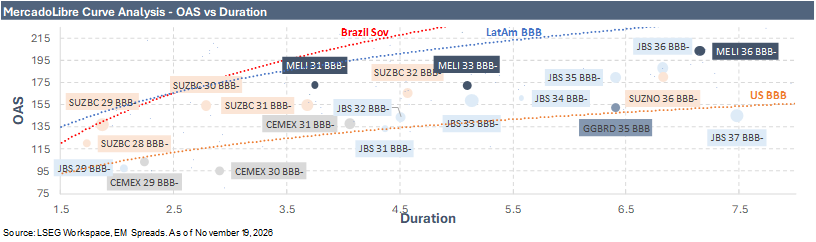
We maintain our Neutral recommendation on MercadoLibre (Baa3/BBB-/BBB-) and upgrade the MELI 3.125% 2031 notes to a bond-level Overweight. The rationale has changed since our 2Q26 report. At that time, spreads were too tight to compensate for a balance sheet expanding faster than earnings, and valuation was the main obstacle to a more constructive call. Since the 2Q26 publication date, the 2031s and 2033s have widened 42 bps and 41 bps, respectively, compared with 17 bps for the EM BBB corporate index. The constraint is now the credit trajectory rather than valuation. Gross leverage increased to 4.10x from 3.39x in 2Q26, and our base case keeps it around or above 4.0x through 3Q27, so we see no meaningful deleveraging within our 6–12 month investment horizon that would support an issuer-level Overweight. The bond-level upgrade is a valuation decision. Over the same period, the 2031s have cheapened 14–23 bps against similarly dated BBB- peers and 12 bps against the Brazil 2031s, and they now offer the same spread as the 2033s with 1.4 years less duration. We think that dislocation justifies an Overweight on the shorter bond without changing our issuer view.
For bondholders, the leverage increase requires qualification. Fintech debt reached $9.69 billion, against $13.04 billion of loans receivable net of allowances, or about 1.35x asset coverage, although the two do not form a perfectly matched funding perimeter. Net leverage excluding Fintech debt remained negative at 0.42x, compared with negative 0.47x in 2Q26, with higher operating leases accounting for most of the change. We therefore do not read consolidated gross leverage of 4.10x as we would for a conventional corporate borrower. The concern is cash conversion. LTM adjusted free cash flow of $1.21 billion represented only about 7.5% of total debt, and the quarter’s improvement depended heavily on a $941 million sequential increase in net Fintech funding, not on stronger operating cash generation. Available cash and investments covered current financial debt and lease obligations by 1.08x, or 1.47x excluding non-recourse securitization debt, but most of the liquidity increase came from additional corporate borrowing. We view refinancing risk as manageable. What limits balance-sheet improvement is the expanding funding requirement of Fintech.