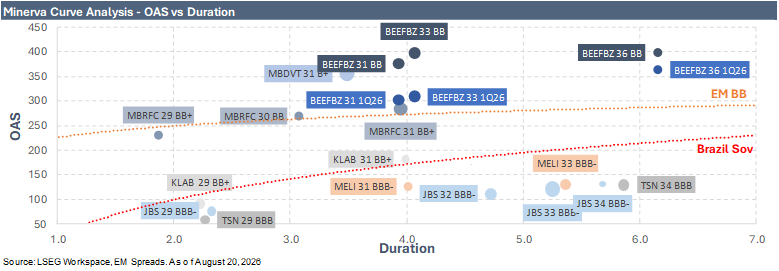
We upgrade Minerva (Ba3/BB/BB) to Overweight from Neutral and prefer the BEEFBZ 4.375% 2031 notes as the cleanest risk-adjusted expression of the credit. The upgrade is valuation-driven and does not rest on a clean fundamental inflection. Credit metrics weakened sequentially, working capital remains a drag on cash generation, and supplier finance has become a more meaningful component of adjusted leverage. Liquidity nevertheless remains strong, conventional net leverage is still materially below year-ago levels, and the intermediate bonds have repriced substantially more than the broader EM BB market. We think current spreads now provide sufficient compensation for the remaining credit risks.
The fundamental picture remains mixed. Net leverage increased to 2.94x from 2.77x, while cash interest coverage declined to 1.66x from 1.93x. Supplier finance increased R$744 million QoQ to R$4.70 billion, more than reversing the R$399 million decline recorded in 1Q26 and lifting adjusted net leverage to 3.90x from 3.56x. We therefore view interest coverage and adjusted leverage, rather than liquidity or refinancing risk, as the principal balance-sheet constraints. The increase in gross debt largely reflected deliberate prefunding, while net debt rose only R$667 million sequentially. Cash covers short-term debt by approximately 2.7x and is sufficient to cover scheduled maturities through 2029.
Cash conversion is the main fundamental swing factor. Free cash flow before working capital was positive in 2Q26, with the reported outflow driven by a R$1.07 billion working-capital investment. Management expects part of the first-half receivables and inventory build to begin converting into cash in 3Q26 and indicated that roughly R$3 billion of inventory could be monetized in the near term, potentially reducing leverage by 0.5x to 0.6x. We expect second-half cash generation to improve, but we do not underwrite management’s 2.2x to 2.3x year-end leverage path. China’s import quota is already a constraint on Brazilian export flexibility in 3Q26, and the risk, in our view, extends beyond the timing of the working-capital release. A tighter Brazilian cattle cycle could keep earnings and cash conversion constrained into 2027 even if inventories normalize in 2H26, limiting the pace of subsequent deleveraging. Strong global beef pricing and Minerva’s export platform should provide some support, but we do not assume they fully offset higher cattle costs.