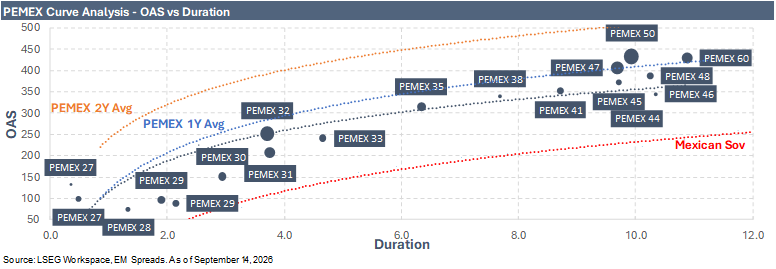
We maintain our Overweight recommendation on Pemex, with lower conviction, and change our preferred expression for new money to the 7.690% 2050s. We retain the 6.625% 2035s as the core lower-duration position for accounts that do not want long-end volatility. For accounts with duration flexibility, we would rotate front-end positions into the 2035s or 2050s; we would retain the front end only for short-duration mandates prioritizing downside protection. We view Mexico’s proposed 2027 budget as neutral to modestly positive for the credit. The P$81.1 billion transfer allocated to Pemex debt service is approximately 69% below the P$263.5 billion budgeted for 2026, but we do not interpret the reduction as a withdrawal of sovereign support. It primarily reflects the decline in near-term refinancing needs produced by Mexico’s liability-management strategy rather than an improvement in Pemex’s standalone cash generation. Explicit support remains in the budget, while the 2027 financing framework preserves substantial domestic and external borrowing authorization.
The more consequential change for bondholders since our 2Q26 report is where the refinancing improvement is now reflected in the curve. The front end has tightened sharply, while intermediate and long-dated bonds have widened. The 5.350% 2028s are 34 bps tighter at 75 bps OAS and the 8.750% June 2029s 22 bps tighter at 96 bps, while the 6.625% 2035s are 12 bps wider at 315 bps and the 7.690% 2050s 21 bps wider at 433 bps. The curve is now distinguishing more clearly between the refinancing risk sovereign action has reduced and the longer-term risks that remain, including dependence on support, weak standalone cash generation and operating execution.