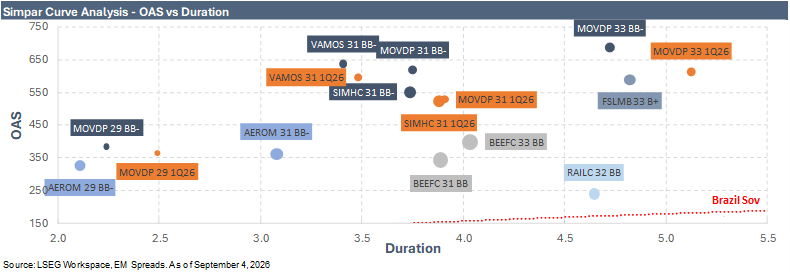
We maintain our Neutral recommendation on Simpar (Ba3/BB-/BB-) at the issuer level and move our preferred bond expression to the MOVIBZ 9.700% 2033 notes from the MOVIBZ 5.250% 2031s. This is a different Neutral from 1Q26. Then, improving fundamentals were offset by spreads that had already compressed substantially. Today, the bonds are materially wider and the operating evidence is stronger, but thin debt-service capacity remains a central constraint and has become more consequential as the expected decline in Brazilian rates has been pushed further out. Simpar still directs roughly half of EBITDA and more than four-fifths of EBIT to interest. We think that leaves too little financial headroom for an issuer-level Overweight, even as the repricing creates attractive bond-specific opportunities.
The operating improvement is real. Adjusted EBITDA increased 5.3% QoQ and 15.7% YoY to R$3.36 billion, while the EBITDA margin reached 29.9%. Service revenue strengthened as asset sales declined, improving the earnings mix. Gross leverage fell to 4.3x from 4.6x, net leverage to 3.2x from 3.5x and bond covenant leverage to 2.8x. Holding-company net debt also declined to R$1.4 billion and would have been approximately R$978 million pro forma for Porto Aratu, while R$350 million of the R$1.0 billion 2026 debt-repurchase target had been completed by July. These changes improve the downside profile and materially reduce the weight we assign to holdco refinancing risk.
Coverage, however, remains thin. EBITDA interest coverage improved to 1.98x from 1.86x in 1Q26, while EBIT interest coverage improved to 1.24x from 1.16x. For an asset-intensive leasing group, we place particular weight on EBIT coverage because depreciation and recurring fleet replacement represent real economic costs. At 1.24x, interest still absorbs more than four-fifths of EBIT, leaving limited room for weaker utilization, higher funding costs or another period of elevated investment. We do not think the modest improvement is enough to change the debt-service constraint in a higher-for-longer Brazilian rate environment.