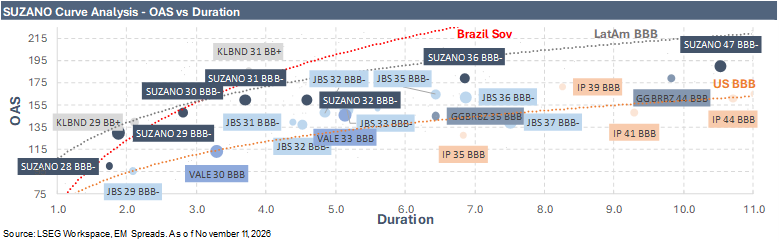
We maintain our Neutral recommendation on Suzano (Baa/BBB-/BBB-) at the issuer level. At the bond level, we shift our Overweight recommendation from the 3.125% 2032 notes to the 5.000% 2030 notes. We move the 2032s to Neutral but retain them as our preferred higher-duration alternative. The reasons behind our issuer stance have shifted since our 2Q26 report. Operating conditions and cash generation have improved, and Suzano has absorbed Arbex with pro forma leverage broadly stable. Further deleveraging remains necessary, and the 2032s and the long end have outperformed the EM BBB index, leaving less value at the issuer level. The switch between the 2030s and 2032s is a separate relative-value decision. The 2032s have tightened by 22 bps relative to the 2030s since our 2Q26 report, narrowing the differential from 34 bps to 12 bps, below its three-month and one-year averages of 20 bps and 21 bps, respectively. With that relative-value trade largely played out, we prefer the carry of the shorter bond to a belly that no longer pays for extension.
We continue to view Suzano as a high-quality investment-grade LatAm credit, anchored by its global cost leadership in hardwood pulp and substantial hard-currency revenues. The 3Q26 results confirmed the recovery in existing operations, and we expect further improvement in 4Q26, supported by October pulp price increases implemented without concessions and the delay of additional Indonesian capacity, which tightens near-term supply. Higher energy and chemical costs and continued losses at Suzano Packaging US should absorb part of that benefit, while the increase in 2026 pulp cash cost guidance to approximately R$825/t leaves limited scope for further cost relief this year. Cash conversion is the more encouraging signal for bondholders. Suzano generated R$1.61 billion of net free cash flow before acquisition-related payments despite a heavier interest schedule, and management reported a US$307 million reduction in net debt excluding Arbex. We expect firmer pulp pricing and seasonal volumes to support further debt reduction in 4Q26, helped by a lighter interest schedule. Management’s objective of net debt below US$14.0 billion by year-end is achievable under favorable operating and working-capital conditions, but we do not incorporate the full reduction into our base case.