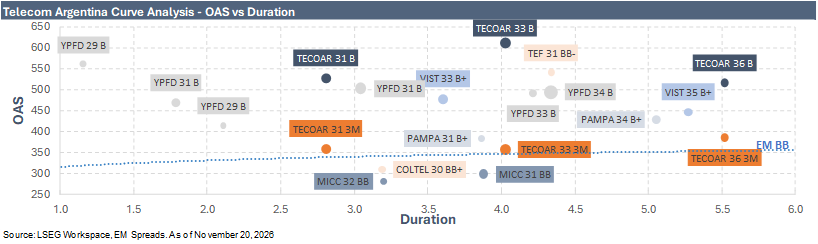
We maintain our Neutral recommendation on Telecom Argentina (B1/B/B-) and upgrade the TECOAR 9.250% 2033 notes to a bond-level Overweight. We named the 2033s our preferred maturity in our October note on the Metrotel offer, and the 2031s and 2036s remain at Neutral. The upgrade is a valuation call. The 2033s have widened 327 bps since our 2Q26 report and are now the widest bond on Telecom’s curve, while the 2036s trade inside both shorter bonds despite their longer duration. The issuer Neutral rests on different grounds than in 2Q26, when spreads already reflected most of the credit improvement. Spreads are now much wider, but the repricing has been driven primarily by Argentine sovereign risk rather than by any deterioration in Telecom’s credit, and we do not think a peso-earning issuer with dollar debt is the right vehicle for a broad view that this risk will fade. The value, in our view, is concentrated in the 2033s, which have cheapened against the EM B index and Argentine peers by more than the rest of the curve.
The balance sheet strengthened again in 3Q26, but we see limited room for further deleveraging from here. Net leverage declined to 1.30x from 1.48x in June, and FFO to debt rose to 47.5%. Liquid assets covered short-term debt 0.96x and the US$208 million of principal due in the rest of 2026 3.82x, so near-term debt service is not a concern. The quarter’s cash flow is not a run rate, since about US$170 million of capex recognized in 3Q26 had not yet been paid, and the heavier cash needs are still ahead. Income tax of about US$360 million is likely to fall due largely in 2027, and integration costs may come forward into 4Q26. The authorization to pay up to US$300 million of dividends before year-end also remains open, although the board had not used it by mid-November. With part of the EBITDA leaving with the Metrotel package, we expect net leverage to hold around current levels through 2027, after a 0.76x decline over the past twelve months.
The Metrotel agreement, which we assessed in our October note, defines the buyer and the asset package, but the economics of what Telecom retains are still open. Of the US$450 million consideration, only the asset payments, due in three annual installments, resemble disposal proceeds, and the split between those and the five-year guaranteed services minimum is not disclosed. We would not count the deferred payments toward debt reduction before they are collected. Most of the value comes over several years from a buyer that generated about US$24 million of EBITDA in 2025, which leaves the deferred receipts as a counterparty exposure until Metrotel’s financing or guarantees are visible. We keep our estimate of US$140–165 million of annual EBITDA at risk from the divested mobile customers, before service income from Metrotel. The transfer of about 6 million mobile customers, roughly 17% of the combined Argentine base excluding machine-to-machine lines, also leaves Telecom facing a larger competitor in its retained market.